6 full lessons
Written in plain language, illustrated, and kept as a reference afterward.
Outdoors and hosting · the slow class
Attention before expertise. Learn to be quiet in nature, keep a field journal that records real observations, and turn what you notice into science that helps the working coast.
Six lessons on quiet attention at the water, keeping a field journal a scientist could use, knowing your shore across seasons, turning your notes into community science through iNaturalist, sharing quiet places with other people, and reading your own journal toward the foraging rules and the kitchen. The course draws on many field guides and readings, including Alexis Pauline Gumbs's Undrowned and Wallace J. Nichols's Blue Mind. This class is not a professional certification, and it says so plainly; take it self-paced and you receive a completion record, take it with reviewed work and you earn a certificate of completion.
6 lessons · about 12 contact hours
$95 once, or $95 on Driftline. Add $60 and Jules reads and grades one real piece of work, passing at 80 percent. Review is optional. Nothing here is accredited or carries credit.
Pay once, and it is yours to come back to. Pick how you want to take it.
On your own
The whole class, the practice work, and the knowledge checks. No pass score, no graded work, no certificate gate.
With Jules reading your work
Everything above, plus one real piece of work, "Two weeks of a real field journal", that Jules reads and grades against a rubric you can see before you start. You pass at 80 percent, and you can rewrite and send it back as many times as you need. This is optional, and it is not accredited and carries no continuing education credit.
Already taking this class? You can add review later and pay only the $60 difference.
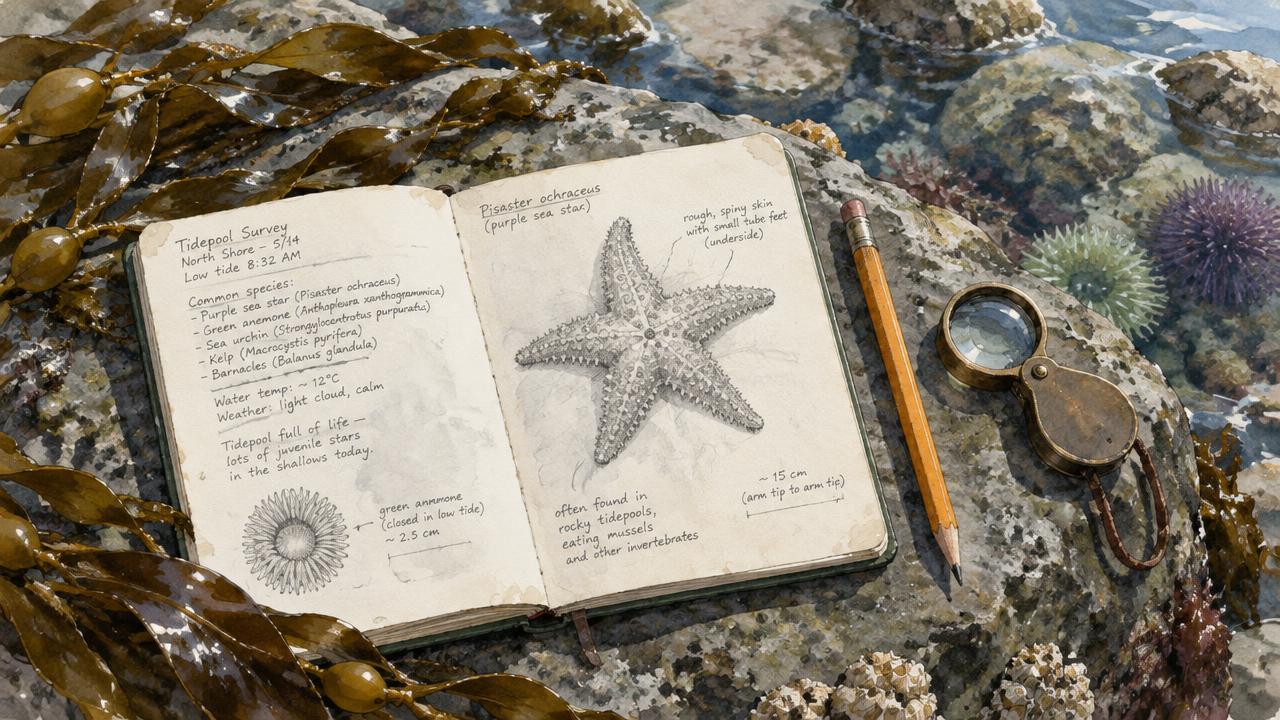
Written in plain language, illustrated, and kept as a reference afterward.
Measured per lesson, with written outcomes, so your time is recorded honestly.
Clear answers and explanations, unlimited tries, and nothing sent to a gradebook.
Rules are shown by state with the source and the date we checked it.
Lesson 1 · 2 h
Lesson 2 · 2.5 h
Lesson 3 · 2.5 h

Lesson 4 · 2 h

Lesson 5 · 1.5 h
Lesson 6 · 1.5 h
We say plainly how well each part of the country is covered, rather than implying the whole country is written to the same depth.
Alaska Fish and Game posts personal use harvest rules for aquatic plants area by area, so the answer in Southeast is not the answer everywhere.
Alaska Department of Fish and Game, Personal Use Aquatic Plants, Southeast · checked 2026-10-02Guiding, gathering, or filming commercially on state park land in Alaska takes a park permit, separate from any fishing or harvest rule.
Alaska Department of Natural Resources, Alaska State Park Permits · checked 2026-10-02Maine publishes its rockweed rules under commercial fisheries, including where harvest is closed. Ownership of intertidal rockweed has also been litigated there, so landowner permission matters.
Maine Department of Marine Resources, Rockweed · checked 2026-10-02Texas publishes general fishing regulations covering fish, mussels, clams, and other aquatic life, and each Gulf state posts its own size and bag limits. Read your own state's current page each season.
Texas Parks and Wildlife Department, General Fishing Regulations · checked 2026-10-02Everyone gets the same lessons, practice work, and knowledge checks. For $60 more you also get one real assignment that Jules reads and grades. You can see exactly how it is judged before you start, you pass at 80 percent, and you can rewrite and send it back as many times as you need. This is optional, and it is still not accredited and carries no continuing education credit.
The assignment
Keep a field journal for two weeks and show what your shore taught you.
Keep a field journal for at least two weeks, with entries that carry date, time, weather, tide, and location, at least one sketch per visit, and honest unknowns where you could not identify something. Post at least two observations to iNaturalist and say what became of them. Then write two pages: the seasonal patterns your entries already show, the species you now know that you did not before, what being quiet in this place has changed for you, and whether guiding, hosting, or the kitchen is the direction you want next.
How it is graded
Entries are usable data · 25 points
Conditions, location, and honest uncertainty are recorded consistently, not just on good days.
Sketching serves information · 25 points
Sketches record shape, size, and position, however rough.
Community science is joined · 25 points
Real observations are posted and their outcome is described.
The reflection is specific · 25 points
Patterns, new knowledge, and a considered next direction are written from the journal itself, not in generalities.
100 points in total. You pass at 80. Jules grades what you worked out, not your formatting or your word count.
The guiding class crosses the line from walking with friends to leading strangers. The kitchen classes pick up where the journal leaves off: cooking what the shore offers.
This course does not carry accreditation, credit, or continuing education units, and completing it does not count toward any outside credential. It is written to the structure a continuing education standard expects, with measured hours, written outcomes, and a completion record you can keep.