6 full lessons
Written in plain language, illustrated, and kept as a reference afterward.
Systems · the work the tide allows
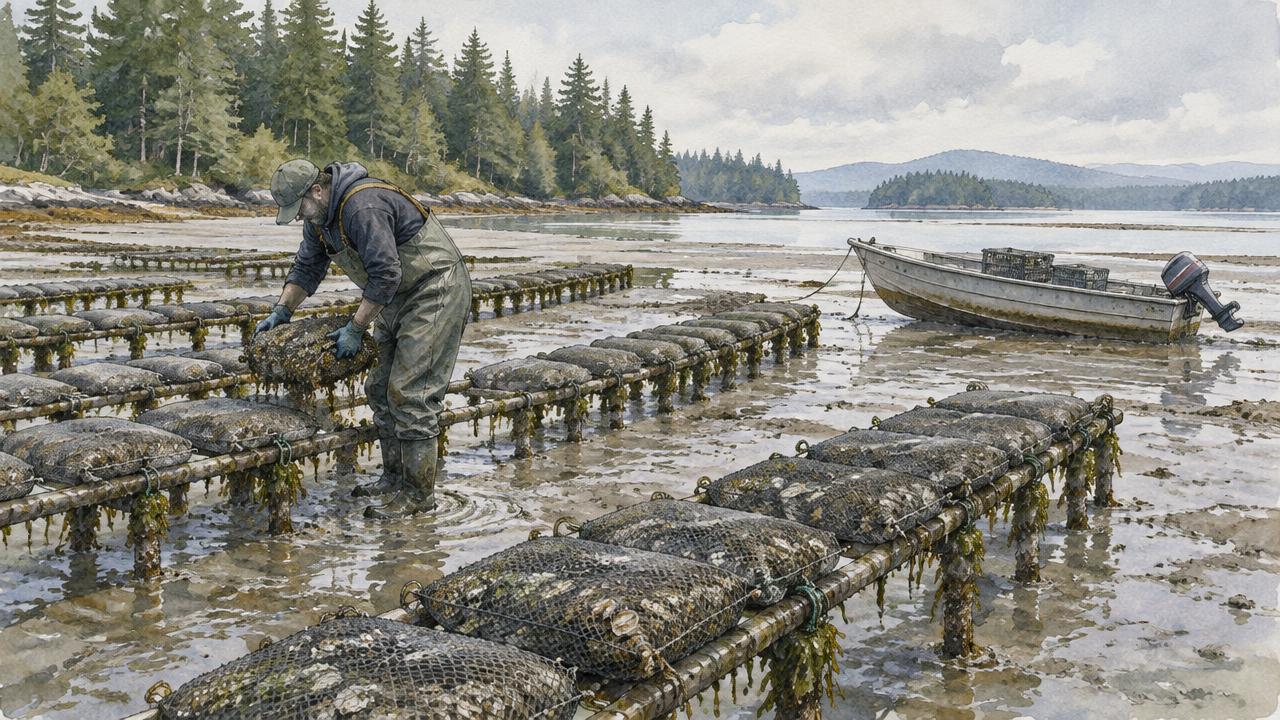
Working a beach or a sheltered lease: tides, gear, ground culture, bags and racks, the crew day, and the neighbors who can see you.
Six lessons on tideland and sheltered-water work: building the day backward from the low tide, reading substrate and predators on a flat, choosing between bottom bags, racks, and floating gear on labor as well as cost, keeping a crew whole through cold and repetition, harvesting inside both the tide and the temperature clock, and staying welcome on the most visible farm there is.
$95 once, or $95 on Driftline. Add $60 and Jules reads and grades one real piece of work, passing at 80 percent. Review is optional. Nothing here is accredited or carries credit.
Pay once, and it is yours to come back to. Pick how you want to take it.
On your own
The whole class, the practice work, and the knowledge checks. No pass score, no graded work, no certificate gate.
With Jules reading your work
Everything above, plus one real piece of work, "Working a tide window", that Jules reads and grades against a rubric you can see before you start. You pass at 80 percent, and you can rewrite and send it back as many times as you need. This is optional, and it is not accredited and carries no continuing education credit.
Already taking this class? You can add review later and pay only the $60 difference.
Written in plain language, illustrated, and kept as a reference afterward.
Measured per lesson, with written outcomes, so your time is recorded honestly.
Clear answers and explanations, unlimited tries, and nothing sent to a gradebook.
Rules are shown by state with the source and the date we checked it.

Lesson 1 · 1.5 h
Lesson 2 · 1.5 h
Lesson 3 · 2 h
Lesson 4 · 1.5 h
Lesson 5 · 2 h

Lesson 6 · 1.5 h
We say plainly how well each part of the country is covered, rather than implying the whole country is written to the same depth.
Published predictions for your nearest station are the basis of every working window. Local wind and pressure can shift the real water level from the prediction, so plan margin.
NOAA Tides and Currents · checked 2026-09-19WDFW keeps the current regulations, and growing-area classification and closures come from the state health authority. A commercial operation works under both at once.
Washington Department of Fish and Wildlife, Shellfishing Regulations · checked 2026-09-19Time and temperature control after harvest, tag contents, and record retention come from the National Shellfish Sanitation Program as your state adopts it.
FDA, National Shellfish Sanitation Program · checked 2026-09-19Eelgrass and other sensitive habitat features are considered in siting and permitting. NOAA publishes the West Coast essential fish habitat material that these reviews draw on.
NOAA Fisheries, Essential Fish Habitat on the West Coast · checked 2026-09-19Everyone gets the same lessons, practice work, and knowledge checks. For $60 more you also get one real assignment that Jules reads and grades. You can see exactly how it is judged before you start, you pass at 80 percent, and you can rewrite and send it back as many times as you need. This is optional, and it is still not accredited and carries no continuing education credit.
The assignment
Plan intertidal work around the water, not the calendar.
Choose an intertidal site and a task. Using real published tide data for a month you choose, identify the workable windows and plan the task into them. Give the crew, the gear, the access route, and the point at which you would call the day off. Then write what changes in the plan in winter. Cite the tide source and any access or permit requirements.
How it is graded
Windows read from real tide data · 25 points
The windows come from published predictions you cite, and the working time in each is calculated, not estimated.
Task fits the window · 25 points
The work you plan can genuinely be done in the time the tide allows, including setup and getting out.
A clear stop rule · 25 points
You state the conditions that end the day and who makes that call.
Access and permission accounted for · 25 points
How you reach the site, and whose permission that needs, are both addressed.
100 points in total. You pass at 80. Jules grades what you worked out, not your formatting or your word count.
Growing-area classification, closures, and tagging come from your state. If you are harvesting shellfish for sale, pair this with Records That Matter and your state's shellfish program requirements.
This course does not carry accreditation, credit, or continuing education units, and completing it does not count toward any outside credential. It is written to the structure a continuing education standard expects, with measured hours, written outcomes, and a completion record you can keep.