
6 full lessons
Written in plain language, illustrated, and kept as a reference afterward.
Systems · a long way from the dock
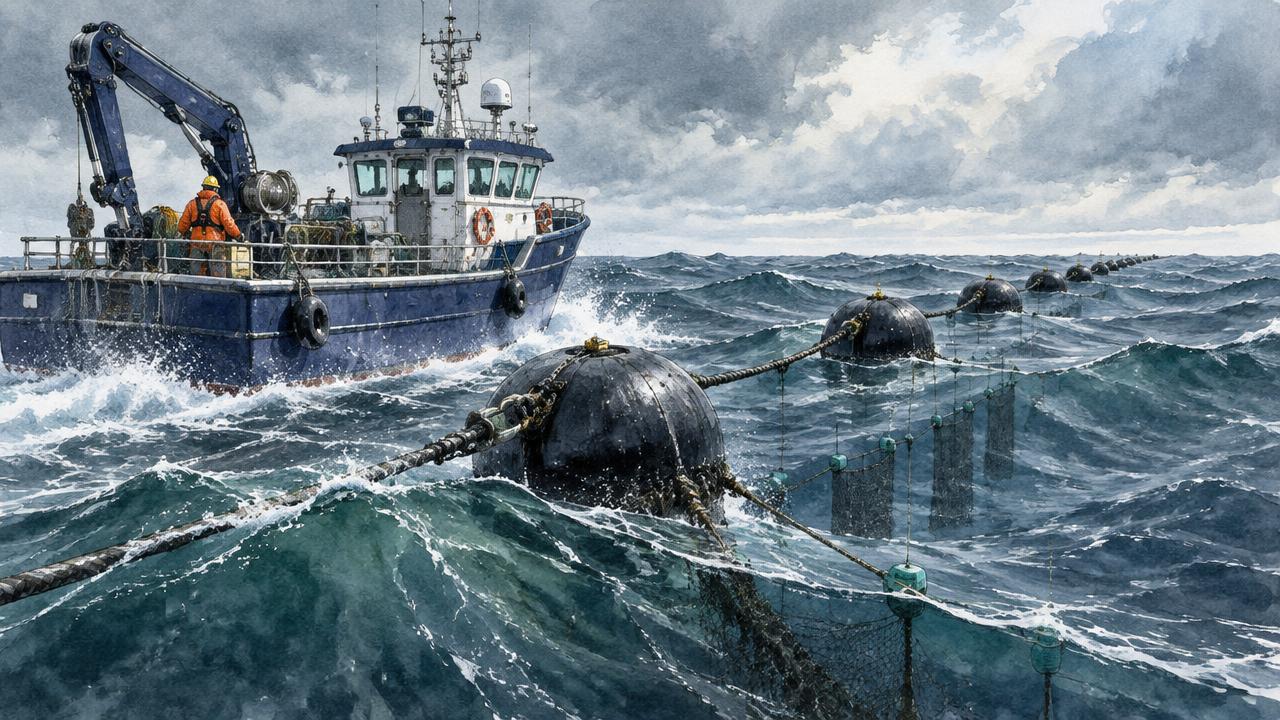
Exposed-water farming in plain terms: moorings and loads, weather windows, boats and crew, federal waters, and the cost of every trip offshore.
Six lessons on exposed-water work: what fetch and wave period actually do to your gear, moorings and the single points of failure that release an array, weather windows and limits written in numbers before the season, offshore safety when help is hours away, the jurisdiction and marking rules that change offshore, and budgeting around the days the sea allows work.
$125 once, or $125 on Driftline. Add $60 and Jules reads and grades one real piece of work, passing at 80 percent. Review is optional. Nothing here is accredited or carries credit.
Pay once, and it is yours to come back to. Pick how you want to take it.
On your own
The whole class, the practice work, and the knowledge checks. No pass score, no graded work, no certificate gate.
With Jules reading your work
Everything above, plus one real piece of work, "An exposed-site risk case", that Jules reads and grades against a rubric you can see before you start. You pass at 80 percent, and you can rewrite and send it back as many times as you need. This is optional, and it is not accredited and carries no continuing education credit.
Already taking this class? You can add review later and pay only the $60 difference.
Written in plain language, illustrated, and kept as a reference afterward.
Measured per lesson, with written outcomes, so your time is recorded honestly.
Clear answers and explanations, unlimited tries, and nothing sent to a gradebook.
Rules are shown by state with the source and the date we checked it.

Lesson 1 · 2 h

Lesson 2 · 2 h
Lesson 3 · 2 h
Lesson 4 · 2 h
Lesson 5 · 2 h
Lesson 6 · 2 h
We say plainly how well each part of the country is covered, rather than implying the whole country is written to the same depth.
The National Weather Service marine forecast is the common reference for go and no-go decisions. Build your limits in the same units the forecast uses.
National Weather Service, Marine Forecasts · checked 2026-09-19NOAA Fisheries keeps the public material on how marine aquaculture is regulated in federal waters, including the agencies with a role in siting.
NOAA Fisheries, Aquaculture · checked 2026-09-19Private aids to navigation are governed by federal regulation and administered by the Coast Guard. Marking is part of the design, not an afterthought.
eCFR, 33 CFR Part 66, Private Aids to Navigation · checked 2026-09-19NIOSH publishes commercial fishing safety material on the hazards offshore crews face. This course teaches planning and judgment and does not substitute for required vessel safety training or drills.
CDC NIOSH, Commercial Fishing Safety · checked 2026-09-19Everyone gets the same lessons, practice work, and knowledge checks. For $60 more you also get one real assignment that Jules reads and grades. You can see exactly how it is judged before you start, you pass at 80 percent, and you can rewrite and send it back as many times as you need. This is optional, and it is still not accredited and carries no continuing education credit.
The assignment
Make the case for or against an open-ocean site, with the weather in it.
Take a proposed open-ocean site and build the case for or against it. Use published wave, wind, and current information for that area. Cover the gear the exposure demands, the number of workable days a year and how you arrived at that figure, the failure you most fear and what it would cost, and the emergency plan. Finish with a go or no-go recommendation that follows your own evidence. Cite every data source with dates.
How it is graded
Conditions taken from real data · 25 points
Wave, wind, and current figures are cited and specific to the area, not regional averages presented as local.
Workable days shown as a calculation · 25 points
The number of workable days is derived on the page, with the assumptions visible.
The worst case costed · 25 points
The failure you name has a cost attached and a reason for the number.
A recommendation that follows the evidence · 25 points
Your go or no-go call matches what you found, including when that means no.
100 points in total. You pass at 80. Jules grades what you worked out, not your formatting or your word count.
This is planning and judgment, not a vessel safety certification. Required drills, survival equipment, and any licensing for your vessel and crew come from the Coast Guard and your state, and they are separate from this course.
This course does not carry accreditation, credit, or continuing education units, and completing it does not count toward any outside credential. It is written to the structure a continuing education standard expects, with measured hours, written outcomes, and a completion record you can keep.