6 full lessons
Written in plain language, illustrated, and kept as a reference afterward.
Systems · growing fish indoors, honestly
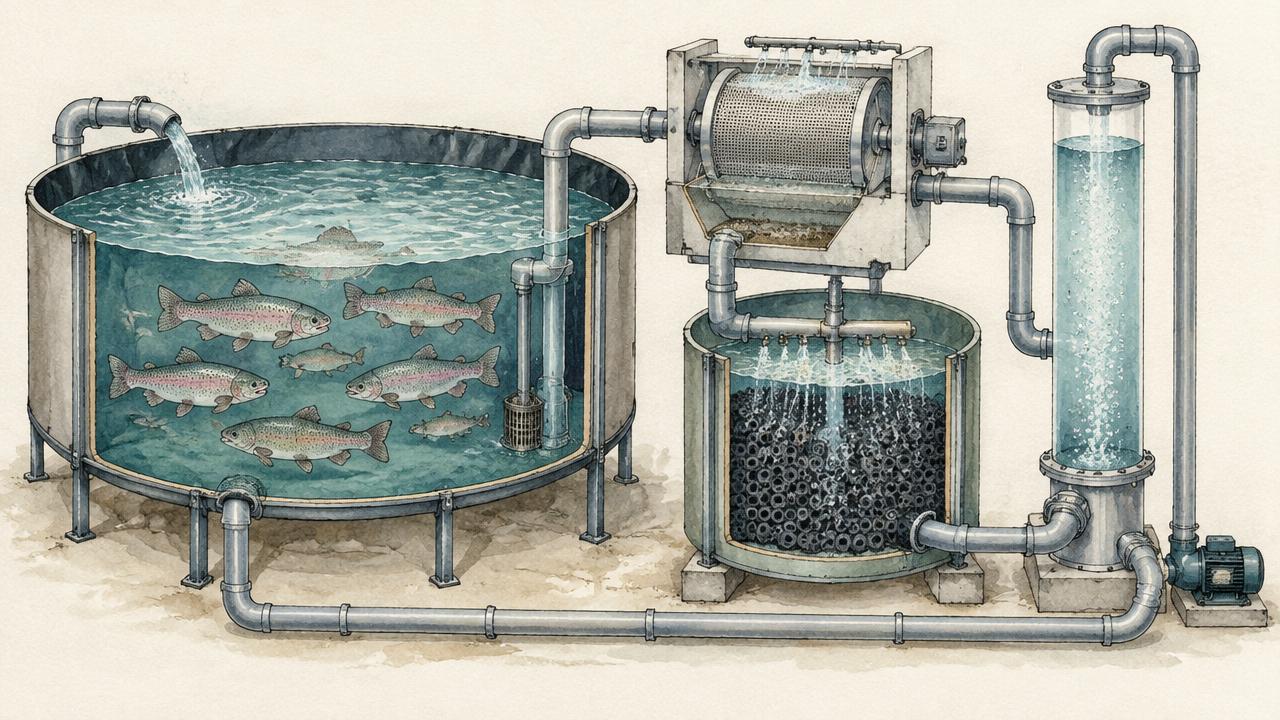
Land-based recirculating systems in plain language: the water loop, the biofilter, oxygen and alarms, fish health, biosecurity, and what the power bill really looks like.
Six lessons on recirculating systems: what you gain and what you pay for it, the water loop stage by stage, the biofilter as a living thing that can be starved or poisoned, why oxygen is the value that kills first and what a real alarm chain looks like, biosecurity in shared water, and the arithmetic that decides whether a facility survives.
$150 once, or $150 on Driftline. Add $60 and Jules reads and grades one real piece of work, passing at 80 percent. Review is optional. Nothing here is accredited or carries credit.
Pay once, and it is yours to come back to. Pick how you want to take it.
On your own
The whole class, the practice work, and the knowledge checks. No pass score, no graded work, no certificate gate.
With Jules reading your work
Everything above, plus one real piece of work, "Read a recirculating system", that Jules reads and grades against a rubric you can see before you start. You pass at 80 percent, and you can rewrite and send it back as many times as you need. This is optional, and it is not accredited and carries no continuing education credit.
Already taking this class? You can add review later and pay only the $60 difference.
Written in plain language, illustrated, and kept as a reference afterward.
Measured per lesson, with written outcomes, so your time is recorded honestly.
Clear answers and explanations, unlimited tries, and nothing sent to a gradebook.
Rules are shown by state with the source and the date we checked it.
Lesson 1 · 1.5 h
Lesson 2 · 2 h
Lesson 3 · 2 h
Lesson 4 · 2 h
Lesson 5 · 2 h

Lesson 6 · 1.5 h
We say plainly how well each part of the country is covered, rather than implying the whole country is written to the same depth.
Water leaving a facility is regulated under the federal clean water permitting program, often administered by your state. Find out early whether your planned discharge needs a permit, because it shapes the whole design.
EPA, aquaculture discharge permitting · checked 2026-09-19Bringing live fish or eggs in, or shipping them out, involves state fish health requirements and federal animal health oversight. Health certificates and approved sources are normal requirements, not extras.
USDA APHIS, aquaculture animal health · checked 2026-09-19Much of the public knowledge about recirculating system design and performance comes from research institutes and land-grant programs that publish openly. Read what already exists before paying anyone to reinvent it.
The Conservation Fund, Freshwater Institute · checked 2026-09-19Nothing here qualifies you to work unsupervised on electrical gear, pressurized oxygen, or confined spaces. Those require real training and, in many cases, certification through your employer or a recognized provider.
NOAA Fisheries, aquaculture · checked 2026-09-19Everyone gets the same lessons, practice work, and knowledge checks. For $60 more you also get one real assignment that Jules reads and grades. You can see exactly how it is judged before you start, you pass at 80 percent, and you can rewrite and send it back as many times as you need. This is optional, and it is still not accredited and carries no continuing education credit.
The assignment
Walk the water around a loop and account for every part of it.
Take a recirculating system, real or from a published design, and follow the water all the way around. For each stage say what it removes or adds, what happens if it fails, and how the operator would know. Then write the daily check sheet an operator would run, with the numbers they are watching and the action at each threshold. Cite your design source and any water-quality targets.
How it is graded
The loop is complete · 25 points
Every stage is accounted for and the water returns where it started, with flows that make sense.
Failure modes with early signals · 25 points
For each stage you name what breaks and the first sign an operator would actually notice.
A check sheet someone could run · 25 points
Numbers, frequency, and the action at each threshold are all present and realistic.
Targets sourced · 25 points
Water-quality numbers come from a source you name, matched to the species.
100 points in total. You pass at 80. Jules grades what you worked out, not your formatting or your word count.
Hands-on work with pressurized oxygen, electrical equipment, and confined spaces needs real training through an employer or a recognized provider. Supervised operating hours come from a job or a college program, not from this course.
This course does not carry accreditation, credit, or continuing education units, and completing it does not count toward any outside credential. It is written to the structure a continuing education standard expects, with measured hours, written outcomes, and a completion record you can keep.