6 full lessons
Written in plain language, illustrated, and kept as a reference afterward.
Working skills · the water, and what you let near it
What the water is telling you, how disease and pests move between sites, and the ordinary habits that keep trouble out of a system.
Six lessons on the water your animals live in and the traffic that brings trouble to them: what each reading means, why oxygen falls before dawn, harmful algal blooms and the closures that follow, the ordinary routes disease and pests travel, a biosecurity plan short enough to follow on a bad day, and the first hour of a die-off, when sampling well is the difference between knowing and guessing.
$95 once, or $95 on Driftline. Add $60 and Jules reads and grades one real piece of work, passing at 80 percent. Review is optional. Nothing here is accredited or carries credit.
Pay once, and it is yours to come back to. Pick how you want to take it.
On your own
The whole class, the practice work, and the knowledge checks. No pass score, no graded work, no certificate gate.
With Jules reading your work
Everything above, plus one real piece of work, "A biosecurity plan you would sign", that Jules reads and grades against a rubric you can see before you start. You pass at 80 percent, and you can rewrite and send it back as many times as you need. This is optional, and it is not accredited and carries no continuing education credit.
Already taking this class? You can add review later and pay only the $60 difference.
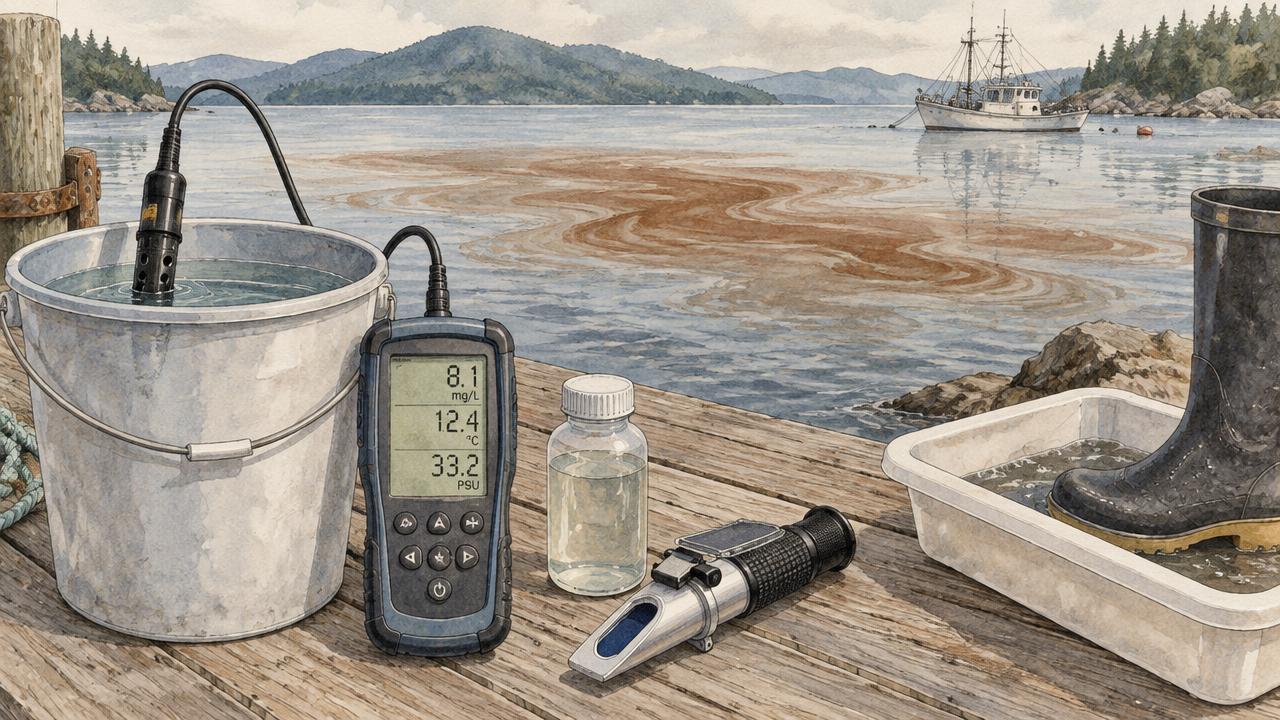
Written in plain language, illustrated, and kept as a reference afterward.
Measured per lesson, with written outcomes, so your time is recorded honestly.
Clear answers and explanations, unlimited tries, and nothing sent to a gradebook.
Rules are shown by state with the source and the date we checked it.
Lesson 1 · 1.5 h

Lesson 2 · 1.5 h
Lesson 3 · 2 h
Lesson 4 · 2 h
Lesson 5 · 2 h
Lesson 6 · 1.5 h
We say plainly how well each part of the country is covered, rather than implying the whole country is written to the same depth.
NOAA runs harmful algal bloom forecasting and monitoring programs, and state shellfish authorities post the closures that follow. Find the page that covers your own water and check it before a harvest day rather than relying on word of mouth.
NOAA, Harmful Algal Blooms · checked 2026-09-19Shellfish growing areas are classified and patrolled under the National Shellfish Sanitation Program, which the states administer. Water quality results feed those classifications directly.
FDA, National Shellfish Sanitation Program · checked 2026-09-19USDA APHIS runs the national aquaculture animal health program, including import and interstate movement requirements. Which diseases are reportable, and to whom, is set by your own state as well.
USDA APHIS, Aquaculture Animal Health · checked 2026-09-19Transfers of live aquatic animals are permitted at the state level, often with a health certificate from an inspected source. Ask before the stock is on the truck, not after.
USDA APHIS, Aquaculture Animal Health · checked 2026-09-19Everyone gets the same lessons, practice work, and knowledge checks. For $60 more you also get one real assignment that Jules reads and grades. You can see exactly how it is judged before you start, you pass at 80 percent, and you can rewrite and send it back as many times as you need. This is optional, and it is still not accredited and carries no continuing education credit.
The assignment
Write the plan for keeping one site's water and stock clean.
For one site, write the biosecurity plan: what comes onto the site, what leaves, and every point where disease or a harmful bloom could enter. Give the monitoring you would run, the thresholds that trigger action, and the actions themselves. Be explicit that diagnosis and official certification belong to a licensed aquatic veterinarian or an approved laboratory, and say at which point you would call one. Cite the programs and agencies you rely on, with dates.
How it is graded
Entry points found, not guessed · 25 points
You have traced the real routes onto and off the site, including people, vehicles, and water.
Monitoring with thresholds · 25 points
What is measured, how often, and the number at which something happens are all stated.
The call to a professional placed correctly · 25 points
You identify the moment a licensed vet or approved lab takes over, and you do not claim their role.
Programs cited · 25 points
The agency programs and published guidance behind your plan are named and dated.
100 points in total. You pass at 80. Jules grades what you worked out, not your formatting or your word count.
Diagnosis, prescription, and official health certification belong to a licensed aquatic veterinarian or an approved laboratory. Find yours before you need one, and check your state's reportable disease list and transfer permit requirements while nothing is wrong.
This course does not carry accreditation, credit, or continuing education units, and completing it does not count toward any outside credential. It is written to the structure a continuing education standard expects, with measured hours, written outcomes, and a completion record you can keep.